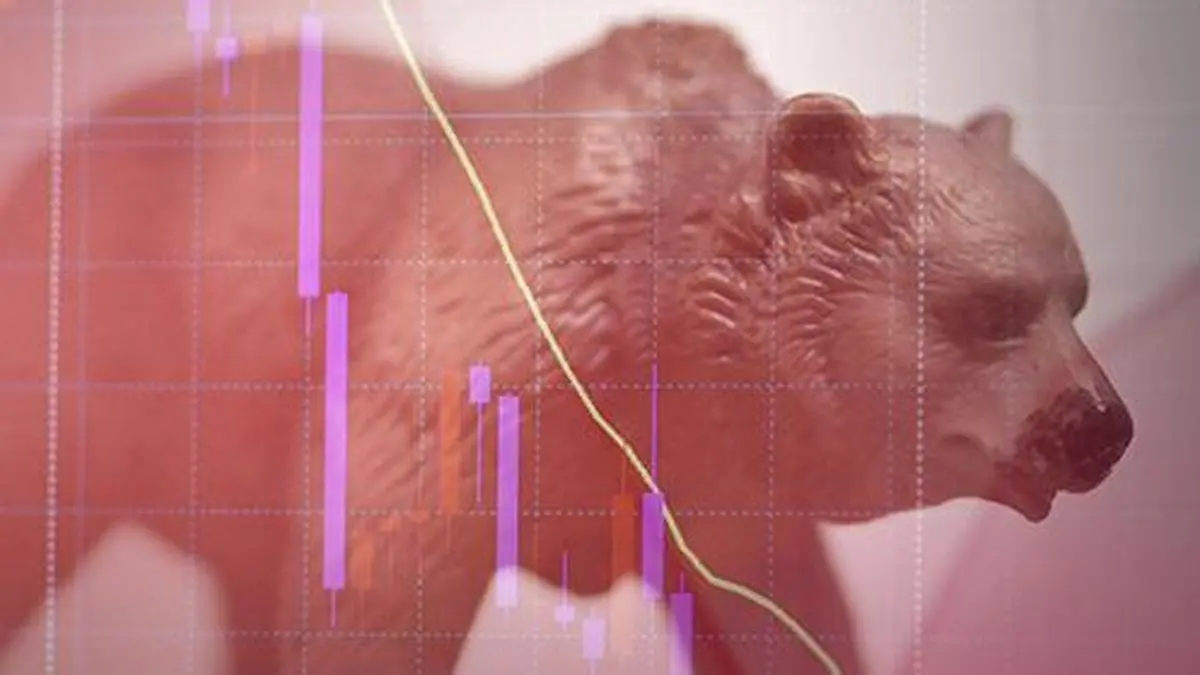
Nifty bleeds for fifth day as $100 oil rattles D-Street
AI Summary
Indian equities faced a significant downturn as Brent crude oil prices surged past $100 a barrel, leading to a five-session losing streak for the Nifty 50 and Sensex. Inflation fears were reignited due to geopolitical tensions in West Asia, and the market reacted to increased expectations of a rate hike amid rising US Treasury yields. Foreign Institutional Investors sold equities worth ₹3,289.31 crore, while domestic investors provided some support with net inflows of ₹3,184.03 crore.
Brent crude crashing through the psychological $100-a-barrel mark sent Indian equities into a five-session tailspin, the longest losing streak in recent memory, as geopolitical flames from West Asia scorched investor confidence and put inflation fears back on the table.
The Nifty 50 closed at 23,767.45, down 0.43 per cent or 102 points on Friday, its lowest closing level since June 12, 2026. For the week, the index shed 2.33 per cent, with all five sessions ending in the red. The Sensex mirrored the decline, falling 0.43 per cent to close at 76,059, down 2,091 points on a weekly basis. The broader market wasn’t spared either: the Nifty Midcap 100 fell 0.10 per cent to close at 61,622, while the Nifty Smallcap 100 slipped 0.32 per cent to 18,874.
“Inflationary fears intensified as the escalation of the West Asia conflict and the blockade at the Red Sea helped crude to cross the $100 per barrel mark...,” said Vinod Nair, Head of Research, Geojit Investments Limited, adding that “...market expectations for a September rate hike have firmed up with both US and domestic yields edging higher during the week.”
Iran’s rejection of a US-backed ceasefire proposal, conveyed through Iraqi mediation, deepened concerns over prolonged supply disruptions through the Strait of Hormuz and the Red Sea, keeping energy markets on edge. Adding to the pressure, the US imposed an additional 10 per cent tariff on select Indian imports, casting a shadow over export-oriented sectors. India’s HSBC Flash Composite PMI also eased sharply to 54.3 in July from 57.1 in June, its slowest pace of private sector expansion in over four years. The US 10-year Treasury yield climbed to around 4.71 per cent, raising the spectre of further foreign capital outflows from emerging markets. The European Central Bank, meanwhile, held its key rate steady at 2.25 per cent but warned that elevated energy prices and geopolitical tensions continue to pose upside risks to inflation.
Sectorally, the week’s pain was concentrated in rate-sensitive pockets. Private banks and realty indices led the losses, each shedding over 4.5 per cent. Auto, metals and energy also dragged. IT, media, and PSU banks closed with marginal gains on Friday. FMCG was the lone sectoral bright spot for the week, rising nearly 1 per cent, buoyed by strong quarterly earnings from sector leaders. Eternal, Bajaj Finance, and Mahindra & Mahindra were among the biggest drags on the Nifty 50.
On the institutional flows front, Foreign Institutional Investors net sold equities worth ₹3,289.31 crore during the week, while Domestic Institutional Investors provided a partial cushion with net inflows of ₹3,184.03 crore. The rupee closed at around ₹96.55 per US dollar, recovering modestly, likely aided by RBI intervention, after crude pulled back from near $101 to around $96.50 a barrel intraday. The US Dollar Index remained firm near 101.30, capping further gains. MCX Gold slipped nearly ₹1,000 to around ₹1,41,800, with COMEX Gold finding support near the $4,000 mark.
The week ahead is lined with critical macro triggers. “...investors will monitor the US Federal Reserve’s policy decision, Federal Reserve Chair Jerome Powell’s commentary and the Bank of Japan’s policy meeting for further cues on the global interest rate outlook,” noted Siddhartha Khemka of Motilal Oswal. Domestically, IIP data and Q1FY27 earnings, including results from IDFC First Bank, AU Small Finance Bank and Birla Corporation, will be closely tracked. Three IPOs, Lohia Corp, Indo-MIM and Xtranet Technologies, are also set to list, with a combined issue size of approximately ₹5,079 crore. Until crude stabilises and geopolitical risks ease, a gradual, stock-specific approach appears to be the dominant market playbook.
Original Article
Published on Hindu BusinessLine